It took 200 years and a cast of thousands to tell the story of the wilderness outpost laid out by John Carlyle Stewart in 1798 to the city that is New Castle today.
A Portrait of an American City begins with the early Native American settlements, the plotting of the land, continues through canal era, the Civil War, heavy industrialization, labor strife, immigration, and on through the urban renewal years to the reawakening and gradual rebirth of the neighborhoods and downtown.
The area was slow to be settled until 1794 when Gen. “Mad” Anthony Wayne defeated the Indians at Fallen Timbers, Ohio. The region became part of the Depreciation Lands, which were used to redeem depreciation certificates issued to Pennsylvania veterans that fought in the Revolutionary War. By 1800, Scots-Irish settlers had a strong foothold in the area.
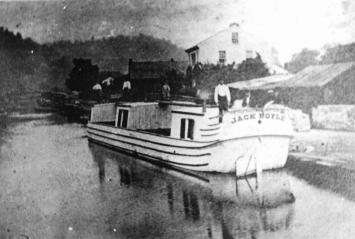
The canals were a boom to the local economy, but a financial disaster for the commonwealth. It cost $519,364 to build the Beaver Division of the canal and in a decade $210,360 was spent to maintain it. However, tolls only brought in $38,312. The canal era ended with the coming of the railroads which offered much greater speed and capacity for freight and passengers, as well as year round service.
The Industrial Boom
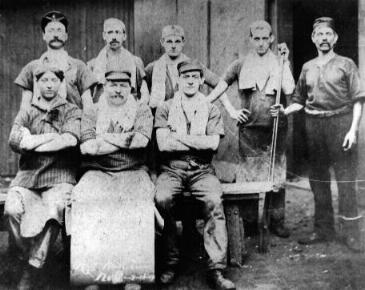
Crew #5 at New Castle tin mill
The McKinley Tariff of 1890 was the highest protective tariff enacted in American history up to that time. It sought to protect already established industries and encourage new industries, such as tin plate. This had monumental implications for New Castle’s economy. America was the leading consumer of tin plate, but had few existing producers.
Local entrepreneurs George and Charles Greer saw an excellent opportunity. With the financial backing of William Foltz and R.F. Cunningham, the Greer’s opened the Greer Tin Mill in 1893. This mill would become the largest in the world.
European Immigrants
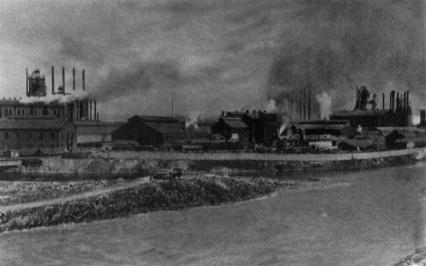
Carnegie Steel Mill and Furnaces, New Castle, PA
Immigrants flocked to New Castle from European countries. The Welsh moved into what had been the Irish settlement of Mahoningtown. The Italians and other ethnic groups followed. The south side of New Castle was growing at three times the rate of the rest of the city, as people needed to live close to their jobs in the mills. New schools, markets, clothing stores, and a hospital were built to serve the growing population.
In the early 1900’s, New Castle was a one-industry town. Individuals and families made decisions based on predictions of how the tin mill was running. Even local entertainment evolved around the mill. Children played at the company playground and attended movies at the Company Theater.
1909 Strike
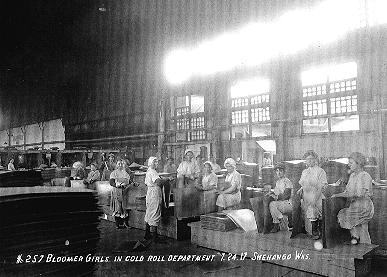
Bloomer Girls in Cold Roll Department at Shenango Works (1917)
Conditions had drastically changed for organized labor by 1909. Mr. Greer had retired. U.S. Steel declared that it would no longer recognize Amalgamated. The strike that followed was long and bitter. Strikebreakers were called in and violence erupted. Many of the strikers never worked in the mills again.
Labor Action
Conditions had drastically changed for organized labor by 1909. Mr. Greer had retired. U.S. Steel declared that it would no longer recognize Amalgamated. The strike that followed was long and bitter. Strikebreakers were called in and violence erupted. Many of the strikers never worked in the mills again.
The Depression
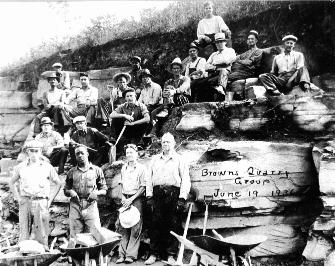
Brown’s Quarry Group (June 19, 1936)
The Depression of the 1930’s ravaged the city. Men were out of work. Many families lost their homes. The threat that had always hung over the city finally became real. U.S. Steel left town for good. In the rapid evolution of tin plate technology, the local plant had become obsolete.
Engineers decided it would be cheaper to build a new plant than to modernize the one in New Castle. Over half of the city’s population was forced to subsist directly or indirectly on relief funds.
“You couldn’t get a job. On every street corner, you would see men, grown men with nothing to do. It was sad. It (the C.C.C. program) was a big help at home. When I went, they sent $22 home and you keep $8. We had good food, but it was cold. We chopped trees to try to keep warm. No one had to tell you to keep busy.”
Current Informational Resources on the CCC (as of October 2015) The Pennsylvania DNCR has an excellent website on the history of the CCC in PA. In addition to historical and factual information, they offer short video interviews and a searchable data base.
Also, there is a group on the photo site FLICKR that was established with the purpose to make photographs of the CCC in Pennsylvania available to all. They offer this “photograph location for the Pennsylvania Civilian Conservation Corps Online Archive. Photographs posted here are copyright free for all to use. If you post a photo here, it is copyright free.”
The Fireworks Capital of America is Born
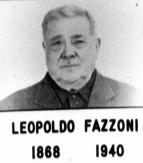
Leopoldo Fazzoni, Father of the New Castle fireworks industry
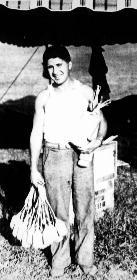
Carrying a load of fireworks
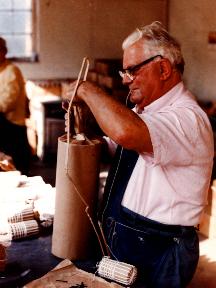
Tying the fireworks
The first fireworks manufacturer in New Castle was Leopold Fazzoni, who owned and operated the Fazzoni Brothers Fireworks Company. Mr. Fazzoni came to New Castle from Italy in 1886 and worked in the tin mills to earn enough money to start his own business.
Mr. Fazzoni was issued the first certificate for fireworks manufacturing in the Commonwealth of Pennsylvania. Of the people who worked with the Fazzoni family, many founded their own businesses, such as: Paul Rozzi, Jacob Conti, Constantino Vitale, and Joseph Zambelli.
Post World War II Prosperity
The G.I. Bill of Rights drastically changed the community after World War II. Men and women had only dreamed of a college education. Now they had an opportunity to attend a university or learn a trade. They were also able to buy homes with no downpayment. They came home from the war to live the American dream. New housing was being built everywhere. Old Centennial Field on the East Side was torn down for a new development. The suburbs also started to grow more rapidly.
We use cookies on our website to give you the most relevant experience by remembering your preferences and repeat visits. By clicking “Accept”, you consent to the use of ALL the cookies.
This website uses cookies to improve your experience while you navigate through the website. Out of these, the cookies that are categorized as necessary are stored on your browser as they are essential for the working of basic functionalities of the website. We also use third-party cookies that help us analyze and understand how you use this website. These cookies will be stored in your browser only with your consent. You also have the option to opt-out of these cookies. But opting out of some of these cookies may affect your browsing experience. You can view our Privacy Policy HERE.
Necessary cookies are absolutely essential for the website to function properly. This category only includes cookies that ensures basic functionalities and security features of the website. These cookies do not store any personal information.
Non-necessary cookies are any cookies that may not be particularly necessary for the website to function and are used specifically to collect user personal data via analytics, ads, and other embedded contents. It is mandatory to procure user consent prior to running these cookies on your website.