Home
Collections
Exhibits
Education
The Museum
The Society
Publications
Walking Tour
Support LCHS
Online GiftShop
DONATE
NOW
Consider a Membership in the Historical
Society
Your donation helps to support our mission to respect the
past and be a cornerstone for the future.
The Lawrence County Historical Society is a tax exempt, charitable
501(c)3 organization. All membership contributions are tax deductible to the
fullest extent of the law.
For over half a century, the Lawrence County Historical Society
has preserved and displayed the heritage of all our citizens.
|
View
Lawrence County Walking Tour on
a Google map

Lower North Hill Tour
|
| |
|
|
 |
|
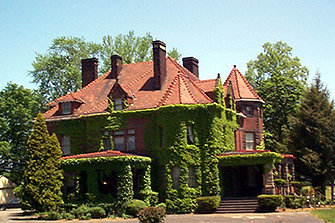
A two and one-half story square plan, patterned
masonry Queen Anne residence has many fine architectural features -
a three story tower with conical roof in the east bay, a two story bay
window with conical roof at the west side and brick cladding with decorative
rough cut stonecourses, quoins and window surrounds. It also has distinctive
red tile rooting and tall interior chimneys with patterned masonry.
|
|
|
|
 |
|
|
The residence was built in 1895 for Mathias Holstein Henderson (1845-1908)
a prominent New Castle resident who served as the vice-president of
the Lawrence Savings and Trust Bank (now National City). Mrs. Henderson
was the daughter of John Bower, a local tailor whose home is also on
the tour. The home is lovingly maintained by the Meehan family.
|
|
|
|
|
 |
|
|
|
| |
|
| |
| |
|
|
| |
| |
|
|
|
|
|
|
|
|
 |

THE CATHEDRAL
110-120 EAST LINCOLN
 |
 |
|
|
It
is difficult to describe the cathedral in a few paragraphs. It is a
neoclassical rectangular plan multi-purpose lodge hall. It is 245 feet
wide, 181 feet deep and 110 feet high in the rear. East and west wings
each 47 feet by 181 feet. It is running bond brick cladding over "fireproof'
(concrete) construction. The foundations consist of 916 concrete piles,
20 to 28 feet long. The main façade (north) is two stories and nine
bays wide. It has two-light windows in freize, the architrave with "Scottish
Rite Cathedral" and monumental engaged stone Ionic columns. The South
façade is high, visible and a major visual resource.
The interior contains a ballroom, banquet room and theater,
as well as Masons' lodge rooms and various smaller chambers. The theater
seating capacity is 3,240, consisting of the main floor and two balconies.
The stage is 80 feet wide and 45 feet 6 inches deep. The
Scottish Rite Cathedral was constructed in 1924-1925 for the FreeMasons
Lodge #433. It was designed by R. G. Schmid Co. of Chicago; S, W. Siesel
Company of Milwaukee and Pittsburgh was the building contractors. Paul
Mueller of New Castle landscaped the grounds. Construction investments
totaled approximately $1,750,000. Note the perfect positioning of the
building on the crest of the hill.
|
|
|
 |
|
|
|
|
|
|
THE GEORGE JOHNSON HOUSE
318 HIGHLAND AVENUE
|
|
 |
 |
|
 |
|
|
T his
two and one-half story square plan Colonial Revival residence has a
coursed limestone foundation, running bond brick walls, hip roof with
north-south main ridge, and tall interior end chimneys with corbelled
caps. It has symmetrical bowed bays, prominent, classically inspired
roof dormers with open pediments, Ionic pilaster and decorative round
top windows. There is a central stained glass window at the second floor
with stained glass circular windows to each side.
The home was built for George W. Johnson (1847-1919)
in 1901. Johnson was a leading local industrialist involved in limestone,
iron and bronze production. He was principal owner of the American Car
and Ship Hardware Company in 1901, which he later purchased and renamed
Johnson Bronze. The home was designed by local architect Harry W. Wirsing.
It now the home of the law offices of Angelo Papa.
|
|
|
 |
|
 |
|
|
|
THE BILLY PATTERSON HOUSE
315 NORTH MERCER
This
two and one-half story, square plan Second Empire residence has common bond
brick walls and mansard roof. It has central, double decorative wood panel
doors with transom. Note the Italianate style brackets. The porch wraps
to the ease side, with paired posts with decorative brackets.
The residence was built prior to 1886 for industrialist
William Patterson (18241905). Patterson was instrumental in developing the
area's coal fields and was the leading organizer of the Aetna Iron Company
in 1868. In partnership with A. L. Crawford, he founded the Crawford Iron
and Steel Company. He also founded the New Castle Nail Company which was
later assumed by Shenango Iron Works and then U. S. Steel. He organized
the Beaver Valley Railroad and the Pennsylvania Engineering Works. In addition
to his industrial activities, Patterson established the Patterson Bank and
was instrumental in founding New Castle's first hospital (The Shenango Valley,
(located on N. Beaver Street). It was recently purchased by the law firm,
Luxenberg, Garbett, Kelly & Sapienza.
|
|
|
|
|
The
charming two and one-half story rectangular plan frame Queen Anne at
the comer of Stewart Place and Highland Avenue has a coursed limestone
foundation, hip roof with lower cross gables, and exterior end brick
chimney with decorative panels. A turret is located in the south bay
with a conical slate roof and a small elaborate spindle balcony in the
North Bay. There is a veranda with spindle work, open balustrade and
frieze.
This residence was built for industrialist
William Reis. Many members of the Reis family lived in the house including
politician William M. Brown (1850-1915) Brown served as Special Agent
of the U. S. Land Office Department, as Pennsylvania Senator from the
47"' district and in 1902 he was elected Lt. Governor of the Commonwealth.
'File house also became the home of Louis T. and Rosena Reis Kurtz during
their brief marriage. It later became the home of the W. H. Shipler
family of Pennsylvania Engineering. It is now being used as a half-way
house.
|
|
 |
|
|
|
|
|
|
|
|
|
 |
 |
JOHN BOWER HOUSE
328 HIGHLAND AVENUE
|
 |
 |
|
|
This
two and one-half story square plan Second Empire residence has a rubble
limestone foundation and running bond brick walls. The Mansard
roof has slate shingles with paired brackets under the eaves. It has
a shed roof porch with pediment over entry, square posts, brackets and
spindle work open balustrade and frieze.
This home was built for John Bower (1821-1906)
between 1886-1889. Mr. Bower was a local merchant and tailor.
It was one of the first large homes built onthe North Hill. This
building suffered a fire several years ago. It is now owned by attorney
Angelo Papa.
|
|
|
|
|
|
|
|
|
THE RANEY JAMESON CASTLE
330 NORTH JEFFERSON
The
Raney-Jameson castle is a two and one-half story, square Queen Anne residence.
It is of coursed, rock faced limestone construction with a limestone foundation.
The main architectural points are the round tower in the south bay with
conical roof, the square turret and the main gable wood with decorative
patterns.
The home was built approximately 1892 for the Leander Raney family. Local
architect, S. W. Foulke, who also designed the First Presbyterian Church
among other buildings in the city, designed it. Mr. Raney, a local industrialist
and community leader was affiliated with the Raney & Burger Iron Works and
Raney Milling Company. He is the grandfather of Howard Kirk of Kirk Hutton
Hardware.
In
1907 David Jameson (1856-1927), one of the founders of Citizens Bank, purchased
the castle. It was through Mr. Jameson's philanthropy the Jameson Memorial
Hospital was established. The Jameson family occupied the home until 1941.
It has served as a nurses home for the hospital from 1941-1963, a dormitory
for the New Castle Business College, and has been a personal care home.
It was badly damaged by a fire in May, 1998 and the original slate roof
cannot be replaced.
THE HOWE-CRAIG HOUSE
214 EAST LINCOLN
This two and one-half story square plan Colonial Revival residence has
a raised, coursed limestone foundation, running bond brick walls, a hip
roof with east-west ridge, and tall, interior end brick chimneys. The main
facade (north) is three bays wide. It has prominent roof dormers. Classically
inspired with open pediments, pilasters and central sunburst motif. There
is regular fenestration of Queen Anne decorative windows, a central bay
window at the second floor and tripartite window with decorative transom
at first floor. Note the Porte cochere to the west side.
This home was built in 1897 for Robert C. Howe, bookkeeper for the New
Castle Wire Nail Company. In 1925, the home was sold to Percy Craig, Vice-president
of Lawrence Savings and Trust Bank.
|
|
|
|
These beautiful homes will be added shortly. We also have
an Industrial History and
a Downtown walking tours.
|
|
|
|
|
|
|
|
Industrial History |
Downtown Walking Tour
|
|
|
|
|